
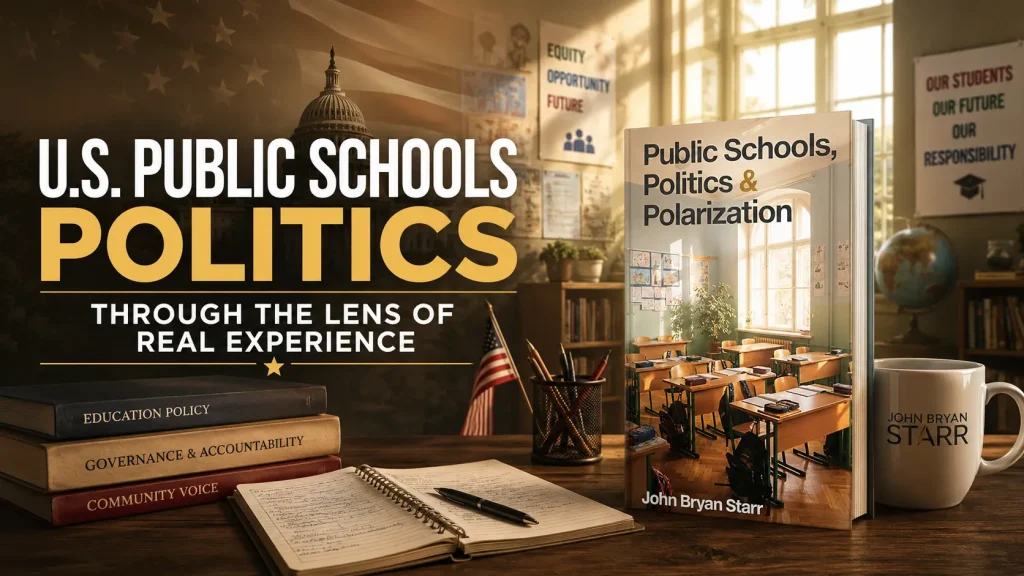
Books by John B Starr didn’t start with China. Instead, it started closer to home. So after decades of studying politics abroad, John Bryan Starr turned his focus somewhere new. Specifically, he looked at U.S. public schools politics. Naturally, that shift surprised some readers. But honestly, it made sense to him.
Here’s why, in short. Politics rarely stays confined to one country or one subject. So Starr spent years tracing how power worked inside China’s government. Then, almost by accident, he noticed the same patterns closer to home. For instance, school boards were splitting apart. Meanwhile, parents were showing up furious at meetings. Also, states were passing laws that flatly contradicted each other. So he did what he always does. He started digging, carefully and patiently, the way he’d done for decades.
Why U.S. Public Schools Politics Caught His Attention
So why the switch, exactly? Well, politics doesn’t stay in one lane. First, Starr spent years studying power in China. Then he noticed something familiar. It was happening closer to home. So school boards were clashing. Meanwhile, parents were fighting. Also, states were passing conflicting laws. So he started digging. Eventually, that digging became a book. It’s called Public Schools, Politics & Polarization. And it’s built entirely around U.S. public schools politics.
The Players He Chose To Study
However, he didn’t rush into this topic. Instead, he used the same careful method he’d relied on for years. First, he gathered real case studies. Then he traced the players involved. School boards. Superintendents. Teachers’ unions. State legislatures. Even the federal government. So each one pulls a different direction. Meanwhile, Starr mapped it all out, piece by piece, until the picture actually made sense.
American Education System Politics: How He Got Interested
So here’s the thing about his career. He built it at three major schools. Specifically, those were UC Berkeley, Yale, and Brown. So education wasn’t distant to him. Instead, it was his daily life for decades. So he watched American education system politics shift from the inside. He wasn’t just reading headlines like everyone else.
What His Mentors Taught Him
First, his mentors taught him something early on. Good research needs real evidence, not just opinions. Plus, years of teaching gave him patience. So he learned to explain messy systems in plain words. Eventually, that skill mattered once he turned toward American education system politics as a serious topic.
So this became a natural next step. Not really a departure. Instead, more like an expansion. After all, he’d spent years explaining hard systems to curious readers. So schools needed that same clarity, too.
Inside Public Schools, Politics & Polarization
So what’s actually inside the book? A lot, honestly. First, it’s a case-study-driven look. It shows how political polarization in schools plays out. Different states. Different districts. However, Starr doesn’t just describe the conflict. Instead, he shows how it actually works day to day.
For example, school boards fight over curriculum. Meanwhile, superintendents get caught in the middle. Also, unions push one way, while state legislatures often push another. Meanwhile, the federal government adds its own pressure. So Starr traces all of it with real examples, not vague generalities. That’s rare for a topic this heated. In fact, most writing on political polarization in schools leans toward opinion. His, instead, leans toward evidence.
Why This Topic Feels So Urgent Right Now
So why does this matter today, specifically? Well, school board meetings make national news now. That almost never happened before. Also, curriculum fights spill into state elections. So parents show up angry. Meanwhile, teachers feel caught in the crossfire. So tension keeps rising, year after year.
Meanwhile, most coverage stays shallow. It captures the yelling. But it skips the structure underneath it. So Starr’s book fills that gap. First, it slows things down. Then it explains why these fights keep repeating across so many states. Plus, it gives readers real context, not just outrage. That context is rare these days. So it’s worth paying attention to.
Finding A Genuine Book About Public Schools Politics
So not every book on this topic actually delivers. That’s exactly why this book about public schools politics stands out. After all, Starr’s credentials aren’t decoration. Instead, decades of peer-reviewed research back them. So do three respected universities.
Also, readers have noticed the difference. For example, reviewers praised his earlier China work for its clarity. So it’s no surprise this book about public school politics carries that same rigor. Instead of picking a side, he shows how the system works. Then he lets readers draw their own conclusions.
A Few Things Readers Notice First
So readers often mention the same thing first. The writing feels calm. It doesn’t shout. Also, it doesn’t oversimplify a messy topic just to sound tidy. Instead, Starr lets the complexity stay complex, while still making it easy to follow.
Plus, the case studies feel real, not hypothetical. They come from actual districts and actual conflicts. So readers get to see the theory play out in practice. That combination, calm tone plus real evidence, is honestly hard to find. Meanwhile, most books on hot-button topics pick one or the other. This one, however, manages both at once.
Beyond One Book: A Different Kind Of Politics
So Starr’s first major book focused on China. This one, instead, turns closer to home. Still, the throughline is obvious. Both books dig into power inside complicated systems. One focuses on foreign policy. The other, meanwhile, focuses on American education system politics instead.
So that range says something about him. He’s not chasing trends. Instead, he follows the questions wherever they lead. Sometimes that’s Beijing. Other times, it’s a school board meeting in Ohio.
So at Books by John B Starr, that range is the whole appeal. Readers curious about political polarization in schools get the same careful voice from his China research. Nothing about the approach changes. Only the subject does.
Conclusion
So in the end, John Bryan Starr brought decades of research home, literally. Then he turned that same careful eye toward U.S. public schools politics. As a result, the book treats a heated topic with real patience, not easy outrage. So if school governance interests you, Books by John B Starr is a solid place to start.
FAQs
Q1: What does the book actually cover?
So it examines U.S. public schools politics through real case studies. Also, it covers school boards, superintendents, unions, state legislatures, and federal involvement.
Q2: Is this book biased toward one political side?
No. Instead, Starr focuses on showing how the system works, rather than pushing a particular argument.
Q3: Who should read this book about public schools politics?
So parents, educators, and school board members should read it. Also, anyone curious about heated education debates will find it useful.
Q4: Does Starr have real experience with education, or just politics?
Yes. In fact, he spent decades at UC Berkeley, Yale, and Brown, so he has direct, long-term exposure to how schools actually operate.